



For raccoons who were happier when food simply appeared.
Raccoon Rating: 🦝🦝🦝🦝
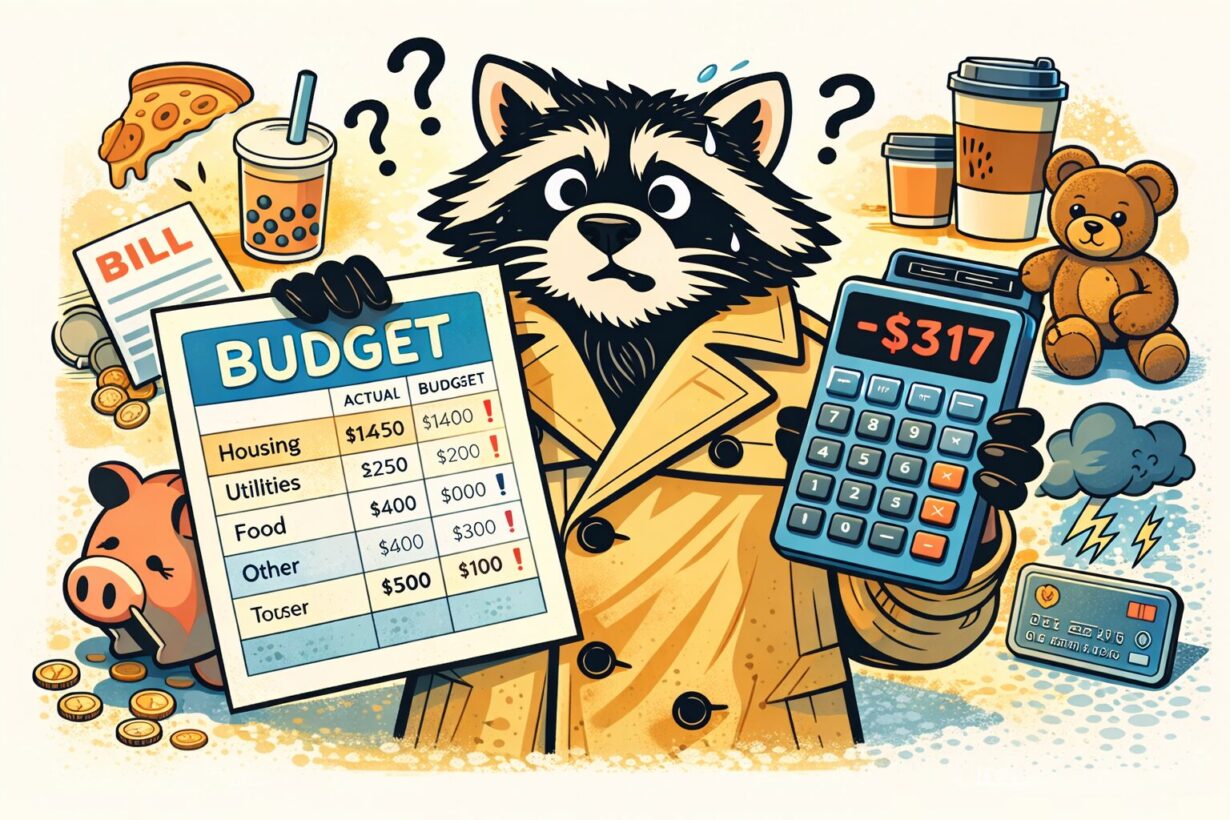
A budget is a human invention designed to make numbers say mean things about your personality.
Before budgets, life was simple. You were hungry. You found food. Sometimes it was good. Sometimes it was deeply questionable. But no spreadsheet ever asked you to explain yourself.
Now you are an adult, and adults are expected to “know where their money goes,” as if money has not been quietly slipping out of your pockets this entire time without leaving a forwarding address.
This guide will explain what a budget actually is, why it feels bad, and how to use one without spiraling.
First: A Budget Is Not a Moral Judgment (Even Though It Feels Like One)
A budget is not:
- a punishment
- a personality test
- proof that you are “bad with money”
A budget is:
- a list of where your money goes
- a tool to help future-you not panic
- a flashlight you shine into the cave, even if there are bats
The reason it feels like a personal attack is because it forces you to notice patterns you were previously ignoring on purpose.
This is uncomfortable. This does not mean you are failing.
Step 1: Understand What Humans Mean by “Budget”
At its core, a budget answers three extremely rude questions:
- How much money comes in?
- Where does it go?
- Is that aligned with what you want?
That’s it. No scolding required.
You do not need:
- fancy apps
- color-coded spreadsheets
- the ability to predict the future
You need awareness and mild courage.
Step 2: Categorize Without Judging Yourself
Humans love categories. Raccoons fear them. We will proceed gently.
Common budget categories include:
- Housing
- Utilities
- Food
- Transportation
- Subscriptions
- “Miscellaneous” (this is where shame lives)
Here is the important part:
Every category is neutral.
“Food” includes groceries and snacks you bought because you were sad.
Both are food.
The budget does not care why.
If you find yourself renaming categories to avoid feelings (“Emergency Treat Allocation”), that is fine.
Step 3: Track Reality, Not Aspirations
The biggest raccoon mistake is budgeting for the person you wish you were.
- “I’ll only eat out once a week.”
- “I won’t buy little drinks.”
- “I will stop impulse-buying comfort objects.”
This version of you is fictional.
Instead, track what you actually spend for one month. No changes. No rules. Just observation.
Think of it as wildlife research. You are studying yourself in your natural habitat.
Step 4: Pick One Thing to Adjust (Not Everything)
Once you see the numbers, your instinct may be to fix everything immediately.
Do not do this.
Choose one small thing:
- One subscription to cancel
- One spending category to cap gently
- One “oh wow” habit to reduce slightly
Budgets fail when they become emotionally overwhelming. Small changes survive.
Step 5: Leave Room for Joy (Yes, Really)
A budget that includes only necessities will collapse.
Humans require:
- treats
- small pleasures
- emotional support purchases
If you remove all joy, you will rebel and buy something unnecessary out of spite.
Instead, intentionally budget for:
- fun
- comfort
- snacks
- the occasional “this made the week survivable”
This is not weakness. This is sustainability.
Why Budgets Feel So Bad at First
Budgets feel bad because:
- They remove the illusion of infinite resources
- They force tradeoffs
- They ask future-you to matter
Raccoons are excellent at living in the moment. Budgets require acknowledging time.
This is a learned skill. It does not come naturally to anyone.
A Very Simple Raccoon Budget Starter
If you want the lowest-effort version:
- Write down monthly income
- Write down fixed expenses (rent, utilities, phone)
- See what’s left
- Decide where that remainder roughly goes
- Adjust one thing
That’s a budget. You did it. No one is mad at you.
Final Note From the Trench Coat
You are not bad with money. You are just used to a system where food appeared and no one asked follow-up questions.
A budget does not exist to shame you. It exists to make sure future-you does not have to panic at 2 a.m. while staring into the financial void.
Do it slowly. Be kind. Leave room for snacks.
You are still allowed to be a raccoon.